
Badminton for kids, explained properly
Most parents who contact us have never played badminton and are quietly working from guesswork — is my child old enough, do I need to buy a racquet, is this a real sport or just a backyard game? This page answers all of that straight, including the parts that don't help us sell anything.
Why badminton
What it actually does for a child
Badminton is the fastest racquet sport there is, and that is not marketing — a smashed shuttle leaves the racquet faster than anything else hit with a bat or a stick. For a child, that speed is the whole point. They cannot get by on strength, so they have to develop the things that are genuinely hard to teach later.
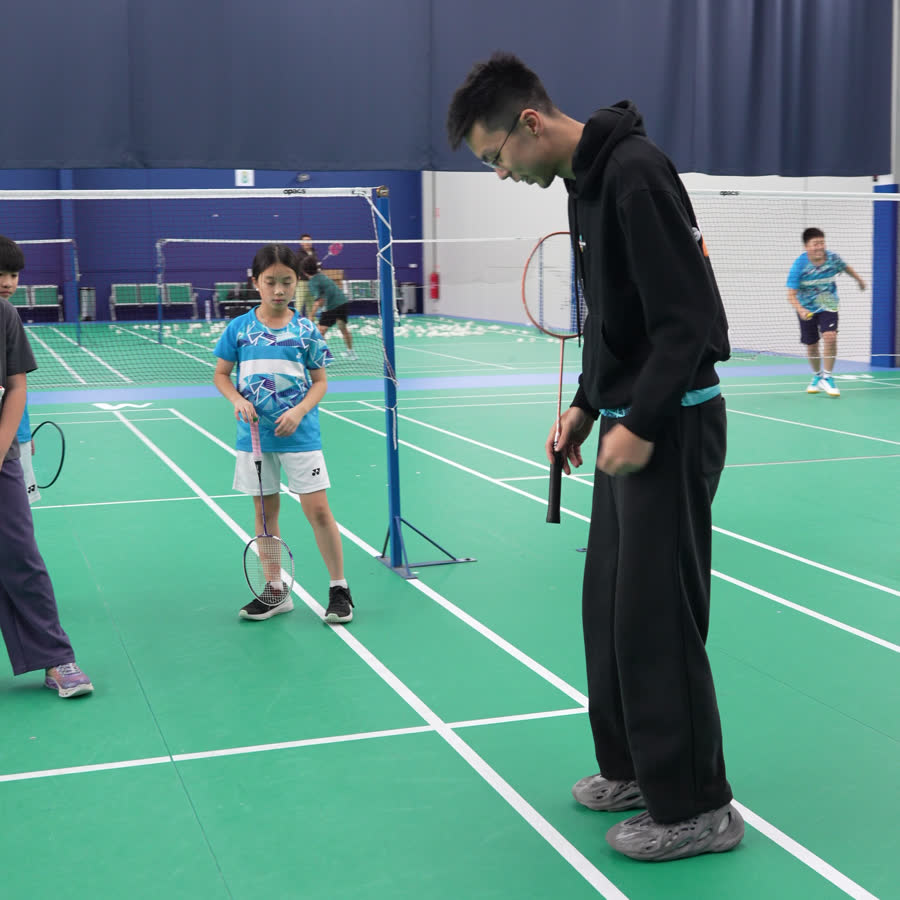
- Reaction speedThe shuttle gives them a fraction of a second to decide. That is trainable, and badminton trains it constantly.
- Footwork and balanceMore of badminton is legs than arms. Children who play it move better at everything else, too.
- Hand-eye coordinationA shuttle decelerates in flight, so it can't be tracked with a simple guess. It has to be read.
- Fitness that doesn't feel like fitnessA rally is interval training. Nobody has to be told to run.
- A sport for small kidsSize and strength matter far less than in football or basketball. Being the smallest in the year is not a disadvantage here — sometimes the reverse.
- Something they can play at fortyIt is low-impact and social, and unlike most junior sports there is a straight path from a school hall to a local club that never closes.
Starting age
What age should a child start?
Around seven is where most children start making fast progress, and it is the age we most often see a beginner click. But the honest answer is that it depends far more on the child than the birthday.
Five and six
Perfectly possible, and plenty do it. Expect the first block to be mostly coordination, racquet control and learning to move — a five-year-old is unlikely to rally properly, and that is not a problem unless someone has told you to expect it. What they gain is the movement base, which makes everything afterwards quicker.
Seven to ten
The sweet spot. Old enough to hold a technique in their head between one week and the next, young enough that nothing has been learnt wrong yet. A child starting here with decent coaching usually looks like a badminton player within a couple of months.
Eleven and up
Still a good time to start, and beginners this age often move faster than younger children because they can understand why a correction matters. The one catch is that self-taught habits are already there and take a few weeks to unpick. Worth doing — a wrong grip does not improve on its own.
The real readiness test has nothing to do with age: can your child follow a two-step instruction from an adult who isn't you, and last an hour without needing to be somewhere else? If yes, they're ready. If not, another six months makes more difference than any amount of coaching.
Equipment
What you actually need to buy
Almost nothing, and you should deliberately buy less than you think for the first couple of months. Badminton is one of the cheapest sports to start — this is a real advantage of it, and anyone telling you otherwise is selling something.
- For a trial classAlmost nothing. Runners, a water bottle and a racquet if you already have one — if you don't, the centres keep rentals at reception. We provide the shuttles.
- ShoesThe one thing worth caring about. Non-marking indoor soles, laced properly. Skate shoes and worn-out runners slide on a sprung floor, and rolled ankles come from footwear far more often than from technique.
- A racquet, eventuallyOnce they've decided they like it. A light beginner's racquet is $30–$60 and is genuinely fine. Do not buy a stiff, expensive one for a child — it is harder to use, not easier.
- ShuttlesPlastic (nylon) shuttles for practice — they last. Feather shuttles fly better and break in an afternoon; they're for later, if ever.
- ClothesWhatever they'd wear to run around in. No uniform needed to start.
If you buy one thing before the second month, make it the shoes. If you buy a second thing, make it a second grip so the racquet doesn't get slippery. That is the entire list.
The game
The shots, in plain English
Badminton isn't one skill. It's a handful of named shots, each with its own technique, and your child will learn to name them too — which is usually the first sign a kid has been coached rather than supervised. When a coach says your child is "working on their clear", this is what they mean.
- The clearAn overhead hit high and deep to the back of the court. The defensive reset, and the shot everything else is built on.
- The smashThe attacking shot, hit steeply downward with power. The one every child wants to learn first and shouldn't.
- The dropThe same overhead action as a clear or a smash, but landing soft and short. Deception, not force.
- The net shotPlayed from the front, dropping just over the tape. The most delicate thing in the sport.
- The liftAn underarm shot from the front of the court back to the rear. How you escape trouble.
- The driveFast and flat, straight over the net. Where quick hands win points.
Underneath all six sits footwork: lunging to the net, moving backwards under a high shuttle, and recovering to the middle afterwards. It is the least glamorous part of the sport and the part that decides everything. We teach it as three ladders of its own — the full roadmap is published here.
Choosing a program
How to tell coaching from supervised play
This is the part worth reading even if you never book with us, because the difference is not visible from the sideline. Both look like children hitting shuttles and having fun. Six months apart, they produce completely different children.
Questions worth asking any program
- How many children per coach? Above about eight, a coach cannot correct individuals — they can only run the group. Ask for the actual number on the day, not the advertised one. Ours is one coach to six children.
- What is my child working on right now? A good answer names a specific thing: the grip, getting under the shuttle, recovering to the middle. A vague answer — "improving", "having fun", "getting there" — usually means nobody is tracking anything.
- How do you know when they've improved? If there's no answer beyond the coach's impression, there's no measurement, and you will find out in a year that little was built. Here's how we answer that one.
- What happens if they miss a week? Illness happens. Whether a program credits it, offers a make-up, or just keeps the money tells you how they think about you.
- Can I watch? The answer should be yes, every week, without arranging it.
Things that look like quality and aren't
- Lots of games. Children love it and learn almost nothing. Games are where you use technique, not where you build it — a session that's mostly matches is a session that's mostly childcare.
- A tired child. Exhaustion measures how much running happened, not how much coaching did.
- Learning to smash in week one. A smash needs a working overhead swing underneath it. Taught early, it produces a hard shot with broken technique that takes a year to fix.
- A big impressive venue. Court quality matters far less than who is standing on it.
Expectations
What the first few months really look like
Deliberately conservative, and deliberately not age-banded — a seven-year-old often absorbs mechanics faster than a thirteen-year-old, and the reverse happens just as often. This is what we hold ourselves to. Most children do better.
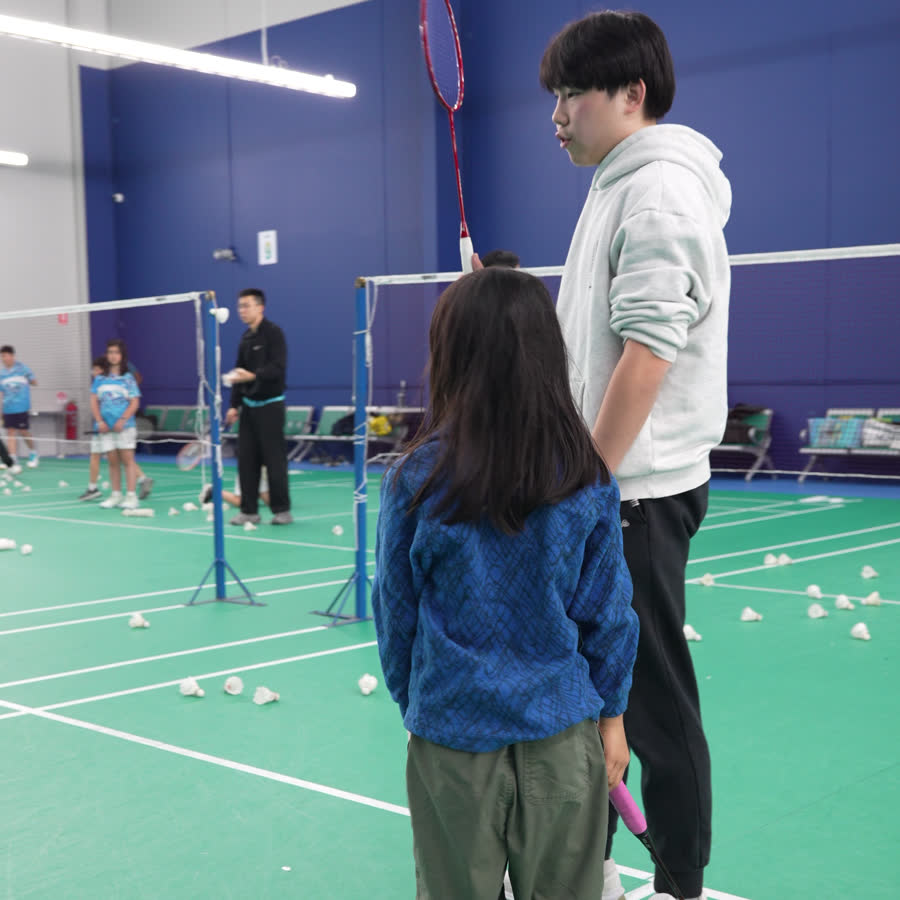
- The first classMostly assessment, though it won't look like it. The coach is reading grip, swing shape, footwork and how your child handles being corrected. No level is earned — we're finding the starting line.
- Week 3 — they look like a playerThey hold the racquet correctly, know the basics of lunging, and have a recognisable overhead and underarm swing. They may still miss the shuttle a lot. That's normal and it comes later than the shape does.
- Week 5 — a coached swingThe swing now genuinely looks trained rather than improvised. Most children can hit an overhead clear reasonably consistently by now, and many have earned their first named level.
- Week 10 — a written reportTypically two named levels earned, specific skills sitting reliably, and a report on where they are and what the next block should focus on.
- Around six monthsRallies rather than exchanges. Footwork that holds up when they don't know where the shuttle is going. This is roughly when a child starts to look, to a stranger, like someone who plays badminton.
The thing nobody tells you. There is usually a flat patch somewhere between weeks four and eight, where a child who improved fast stops visibly improving. It is almost always the moment a skill is moving from "does it when reminded" to "does it without thinking" — the invisible half of learning. Children quit during it. If you know it is coming, it is much easier to sit through.
Honestly
Which kids it suits — and which it doesn't
Badminton tends to suit
- Children who are small for their age, or not fast in a straight line
- Children who've been put off team sport by being blamed for a loss
- Children who like getting visibly better at a specific thing
- Quieter kids — an individual sport with a group around them
- Children who need to burn energy but hate being shouted at
It's a harder sell for
- Children who want contact and collision — this isn't that
- Children who only enjoy sport socially with existing friends
- Children genuinely not ready to take instruction for an hour
- Families wanting a competitive pathway immediately — that comes, but not in the first season
If your child is in the right-hand column, the free trial is still the cheapest way to find out — it costs you an afternoon and nothing else, and we would rather tell you it isn't a fit than take a season's money and watch them drift off.
The first class is free when you book within 7 days of enquiring, and there's no catch in it.
Bring runners, a water bottle and a racquet if you have one — there are rentals at the centre's reception if you don't. We provide the shuttles, and a coach who'll tell you honestly where your child is starting from.